Written By
March 26, 2026
February 26, 2026
September 6, 2022

By Alicia Rule, Mike Vajda, and Sharon Ginley
A four-part article series, toward preparation for the upcoming Federal HCM transition, by the GKG Federal Human Capital and Shared Service Practices:
Preparing for the Federal HCM Transition: Governance, Data Readiness, Capacity, and Continuity
On December 10, 2025, OMB and OPM initiated the most consequential workforce infrastructure consolidation in federal history. By FY 2028, more than 100 agency-specific HR systems will transition to a single governmentwide Core Human Capital Management (HCM) platform affecting every agency, every workforce process, and every federal employee.
This transition is not merely a technology upgrade. It is an enterprise capability stress test. Agencies must modernize while continuing to hire, process personnel actions, run payroll, support mission operations, and maintain compliance without interruption.
The success of this transition will depend less on the Core HCM platform itself and more on each agency’s institutional readiness to execute under sustained operational pressure.
What the Memo Requires vs. What It Doesn’t
Memo Appendix C outlines high-level preparation requirements:
These tasks appear straightforward. In practice, they require coordinated governance, cross-functional leadership, operational capacity planning, and disciplined execution.
The memorandum specifies what agencies must prepare. It does not prescribe how to build the governance, leadership alignment, workforce readiness, and data stewardship necessary to execute successfully.
That gap is where transformation efforts typically fail.
Why This Gap Matters
Agencies vary widely in systems maturity, workforce complexity, analytic capability, and change capacity. Research on large-scale transformations is instructive:
In a federal context, failure does not mean inconvenience. It can mean:
HR systems are not merely transactional platforms. They underpin:
The transition will expose underlying weaknesses in governance, data ownership, and operational resilience. Agencies that prepare deliberately will absorb disruption. Those that do not may amplify it.
Bridging the Gap: Institutional Readiness
This article series addresses four interdependent readiness domains:
We begin where agencies most often underestimate risk: governance. Not simply identifying points of contact, but building the enterprise structure that enables those roles to function effectively under pressure.
Series Article 1
Establishing Effective Governance for the Federal HCM Transition
Governance is not bureaucracy. It is the process that determines whether agencies manage disruption or succumb to it.
As agencies execute the requirement to “identify points of contact,” success will depend less on assigning names and more on creating durable governance that aligns human resources, information technology, planning, security, records, data, and mission leadership.
Without structured governance, large-scale transitions become fragmented, reactive, and fragile.
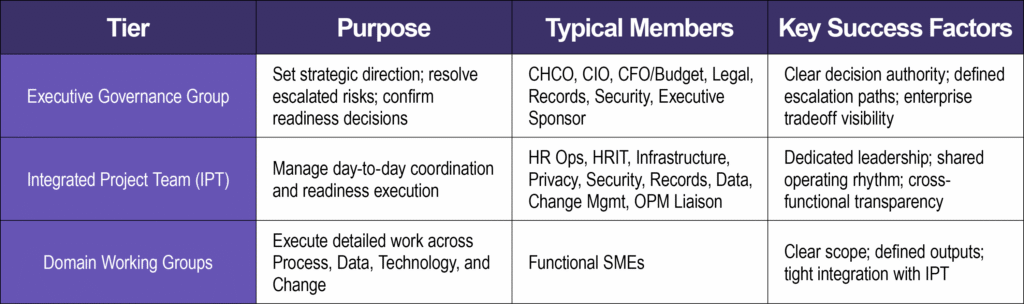
This structure ensures decisions are made at the lowest appropriate level while preserving clear escalation channels when enterprise risks emerge.
Governance Charter: Institutionalizing Authority
A governance charter formalizes:
Without formalization, governance becomes inconsistent and vulnerable to leadership turnover. Agencies should ensure governance would continue to function effectively even if key leaders rotated tomorrow.
Governance as an Institutional Capability
Weak governance does more than slow projects; it fragments data ownership, degrades analytic reliability, and undermines leadership confidence precisely when strategic workforce insight is most critical.
In the absence of disciplined governance:
Agencies that treat governance as a temporary project overlay risk compounding disruption over time.
A GKG Case Study
When a research activity experienced its first Director transition in decades, it faced heightened scrutiny and operational risk at a moment when continuity of scientific leadership was essential.
GKG supported leadership to formalize governance during the transition. This included structuring a cross-functional coordination framework that clarified decision authority, defined roles and approval pathways, standardized executive briefings, and institutionalized knowledge-transfer processes across Institute scientific and administrative processes. The result was not simply smooth onboarding, it was durable governance under pressure.cracy. It is the process that determines whether agencies manage disruption or succumb to it.
Outcomes
Governance Readiness Check
Before declaring governance operational, agencies should answer “yes” to:
Are decision authorities unambiguous?
Are cross-functional dependencies visible?
Are risks escalated and resolved within defined timeframes?
Is documentation sufficient for continuity during leadership transitions?
Any “no” indicates material readiness gaps. In our next article, we will consider data readiness the most fragile and consequential component of transition.
