Written By
August 27, 2026
August 13, 2026
June 18, 2026

An Approach to Leader Selection and Development at Scale
Bob O’Brien, Chief Strategy & Innovation Officer, GKG
Across federal civilian and military agencies, leaders are still chosen mainly on résumés, performance records, and intuition, even though research shows structured assessment is a better predictor of performance. The Department of War’s new Joint Warfighter Evaluation is a meaningful step for uniformed officers, but a single work sample captures only one perspective. Drawing on large-scale military leader assessment experience, this article outlines a proven multi-method approach to selecting and developing leaders and recommends extending it to the Department’s senior civilian workforce.
The Scenario
A few years ago, a senior leader I will call Mike contacted me with a tough problem.
“Bob, one of my subordinate leaders, Jim, is acting exactly how I used to act when I held his job, and I’m close to firing him but I don’t want to do that. I know you have a lot of data on Jim. How can I help him?”
Mike’s question is one most senior leader eventually faces: we know what’s on our leaders’ résumés. But do we know how they’ll decide under pressure, or how they’ll lead day to day? And once they’re in the seat, how do we help them?
Why Leader Selection Matters Now
Leadership quality remains one of the most important determinants of organizational success. Yet many federal selection processes still rely on résumés, career records, supervisor recommendations, unstructured interviews, and the assumption that a great individual performer will automatically be a good leader. Personnel-selection research shows that structured, standardized methods such as structured interviews and work samples are among the strongest predictors of job performance and outperform unstructured, intuition-based approaches. On the civilian side, the Office of Personnel Management (OPM) moved the Senior Executive Service in this direction in 2025, replacing lengthy narrative essays with structured interviews.
The Department of War (DOW) is already moving in this direction. On September 22, 2026, the Secretary of War announced the Joint Warfighter Evaluation (JWE), a standardized assessment of operational planning, decision-making, and leadership under simulated combat conditions for officers competing for their first star. The JWE is an important step: it gives selection boards a common, objective data point that a series of performance reports cannot. But it is one work sample, showing how a leader performs in one situation from one vantage point. To understand a leader well enough to entrust them with an enterprise, an organization must see that leader from multiple perspectives, including those of peers and subordinates. And the Department’s senior civilians, the GS-15s and Senior Executive Service (SES) members who lead its acquisition, sustainment, and enterprise functions, have no JWE equivalent.
OPM Leadership Framework in Figure 1 shows the scale of the challenge. It defines fifteen competencies, and the set a leader must demonstrate grows at each level from team lead to executive. The competencies added at higher levels, such as executive judgment and strategic thinking, are the ones a résumé or interview reveal least.
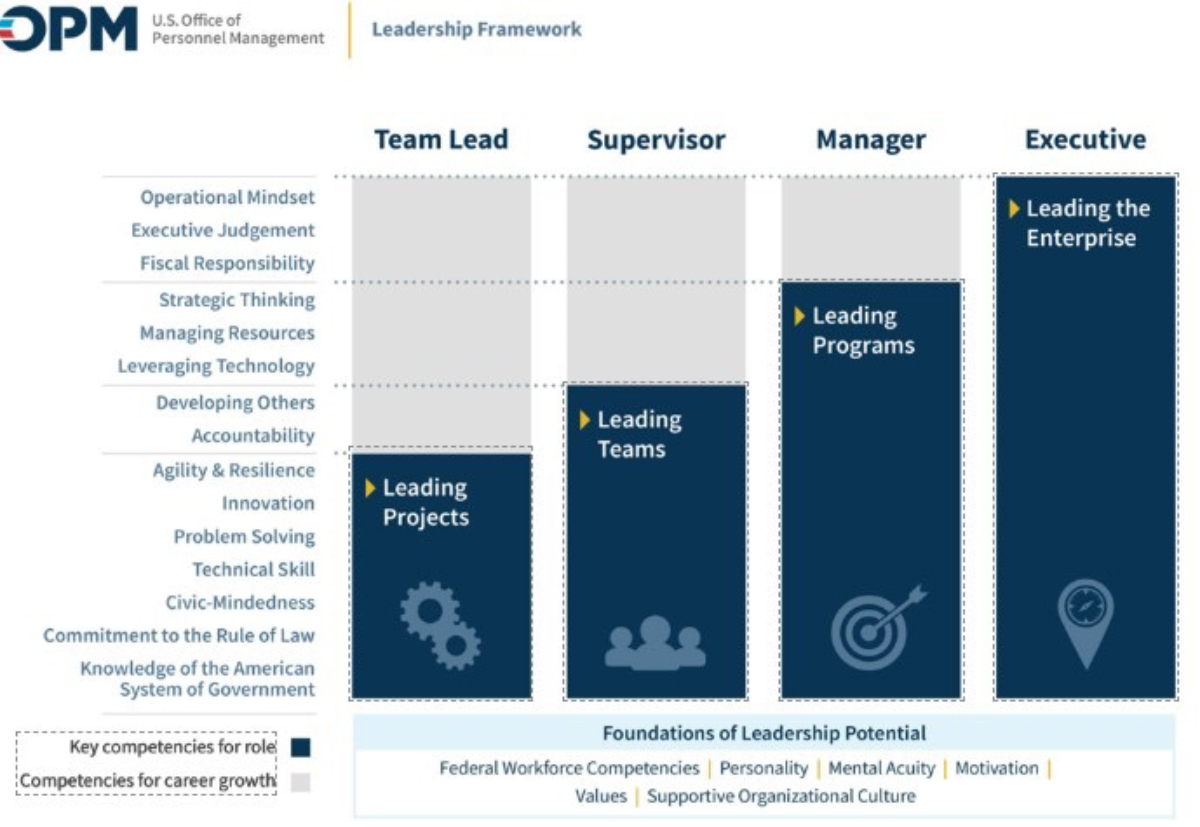
Figure 1. OPM’s Leadership Framework adds competencies at every level from team lead to executive. Most cannot be observed in a résumé or a single interview.
Organizations that systematically and objectively assess leaders from multiple perspectives make better-informed, merit-based leadership decisions than those that rely on experience and intuition alone. Integrated with targeted development, that data selects better leaders today and builds stronger leaders for tomorrow.
A Multi-Method Approach: The Leader Assessment System
Grounded in decades of assessment-center research and practice, the Leader Assessment System (Figure 2) is a structured, multi-method process that objectively assesses a candidate’s demonstrated performance, leadership readiness, and future potential against clearly defined requirements. It serves two connected purposes: informing selection decisions for critical leadership positions and guiding each leader’s continued development using that leader’s own data. The numbered icons below match the four steps in Figure 2.
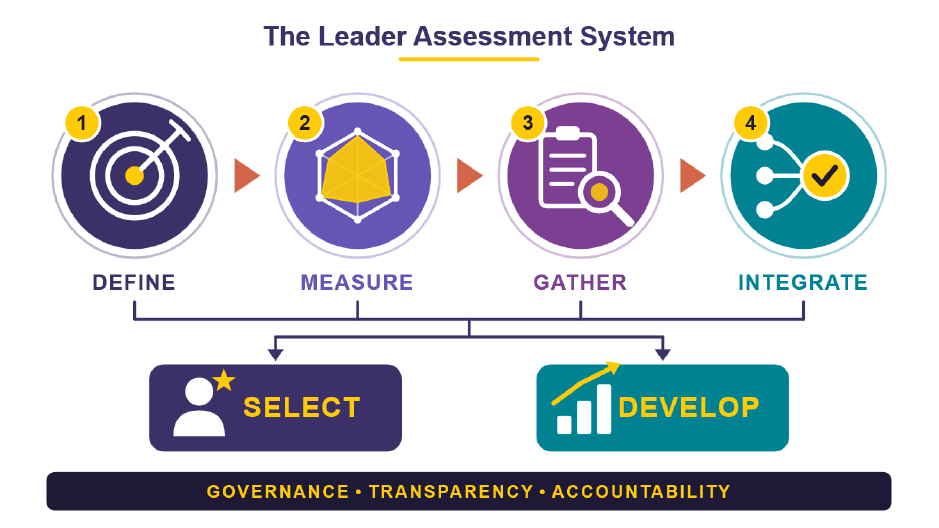
Figure 2. The Leader Assessment System moves through four steps (Define, Measure, Gather, Integrate) to produce objective data that informs both selection and individualized development.
2. Measure. Candidates are assessed across six dimensions: performance (what they have accomplished), potential (what they could accomplish), character (whether they should be entrusted with greater responsibility), learning agility, interpersonal effectiveness, and higher-level thinking.
3. Gather. Evidence comes from multiple complementary methods rather than any single measure: scenario-based work samples with observed behavior, the same principle behind the JWE; 360-degree feedback from peers and subordinates; written and verbal communication assessments; validated cognitive, behavioral, and personality instruments; and structured interviews. Trained, certified assessors evaluate every candidate under standardized conditions against common criteria, rating each independently before results are combined.
4. Integrate. Results are combined across all sources so that no single evaluator, and no single relationship, drives the outcome. That protects selections from favoritism and gives decision makers a fuller, more reliable picture. Each candidate receives specific feedback on strengths and development needs, which is translated into an individual development plan that guides coaching and executive development.
The banner at the base of Figure 2, governance, transparency, and accountability, is the system’s foundation: human judgment remains accountable for every decision, and the system is continuously validated.
Anticipating the Objections
• “We already have boards and performance appraisals.” Keep them. Appraisals describe past performance; assessment adds objective evidence of readiness and potential for roles not yet held. Like the JWE, it supplements rather than replaces.
• “It costs too much and takes too long.” A poor executive selection costs far more in lost talent and degraded mission performance. A focused pilot measures the return before scaling.
• “How will the data be secured?” Treat the data like any sensitive personnel record by restricting access strictly to defined roles. If candidates doubt data security, they will not participate candidly.
Returning to the Scenario
Mike’s call for help was well placed. I reviewed all Jim’s assessment data, taking care not to anchor on any single source. Together, the data pointed to a critical vulnerability: Jim cared deeply about how others perceived him, especially his bosses one and two levels up. That concern drove most of his decisions and produced consistently negative interactions with subordinates and peers, impacting his mission effectiveness. In short, the more Jim focused on what his boss thought, the worse his organization performed. No single exercise would have revealed that pattern; it emerged only when considering peer, subordinate, behavioral, personality, intelligence, and observed data together.
Jim received this feedback during his assessment but did not internalize it. Because Mike understood Jim’s leadership vulnerabilities and challenges, he could directly address them with Jim while there was still time to turn things around. Without multiple data sources, Mike would likely have fired him, and Jim’s organization would have continued to struggle, ultimately failing its mission. That is the value of multi-source assessments: more relevant data informing better selections, and leaders who keep getting better after they are selected.