GKG Mission Capability Partners works with leadership systems navigating complex, high-stakes change. We diagnose and strengthen the enabling layer — the conditions, relationships, and interpretive alignment that determine whether change efforts land and hold.

Most change efforts have the strategy right and the execution capability in place. What breaks them is the enabling layer — the interpretive alignment, relational architecture, and structural conditions that determine whether change actually lands.
Mission-critical leaders are being asked to deliver results amid leadership churn, cross-boundary coordination without clear authority, and continuous operational demands that do not pause for implementation. In these conditions, the gap between what is decided and what actually happens is not a strategy problem. It is a systems problem. MCP builds the underlying organizational infrastructure that closes that gap.

Leadership Transition
A new leader is arriving — or one has just left. The organization needs to absorb the transition without losing momentum, stability, or the people who carry institutional knowledge. We surface what the system needs to hold, align the leadership collective around the change, and build the infrastructure for a durable start.

Decision-Making & Governance
Decisions are slow, contested, or inconsistently made. Authority is unclear. Coordination between teams or across stakeholders creates friction rather than flow. We diagnose where the breakdown lives — in role clarity, decision rights, governance design, or coalition dynamics — and build the structures that let the right decisions get made at the right level.

Sustained Execution Capacity
The pace of change has outrun the organization’s capacity to absorb it. People are exhausted. Strategy feels like it lives on paper. Innovation, collaboration, and sound judgment have all narrowed under sustained pressure. We work with leadership to design operating rhythms that respect how organizations actually function — building the capacity to move through cycles of activation and integration without breaking.
1. Scan
We read the system before we intervene. A diagnostic scan — through survey instrument, structured interviews, or both — surfaces where interpretive variance, stakeholder misalignment, and structural risk are highest. This becomes the evidence base for everything that follows.
2. Align
We bring the leadership collective into structured dialogue — creating the conditions for shared interpretation of the situation. This is not consensus-building. It is sensemaking that produces sufficient shared direction for coordinated action.
2. Operationalize
We support the collective in building the structural and relational architecture that holds the work over time — role clarity, decision rights, governance design, and coalition health. The engagement closes when the collective can sustain the work independently.
Entry point is determined by what the system needs — not by a prescribed sequence. We may enter at any phase depending on context and constraints. Engagements can begin with a lightweight scan and executive debrief, or as a sustained partnership embedded in ongoing operations.
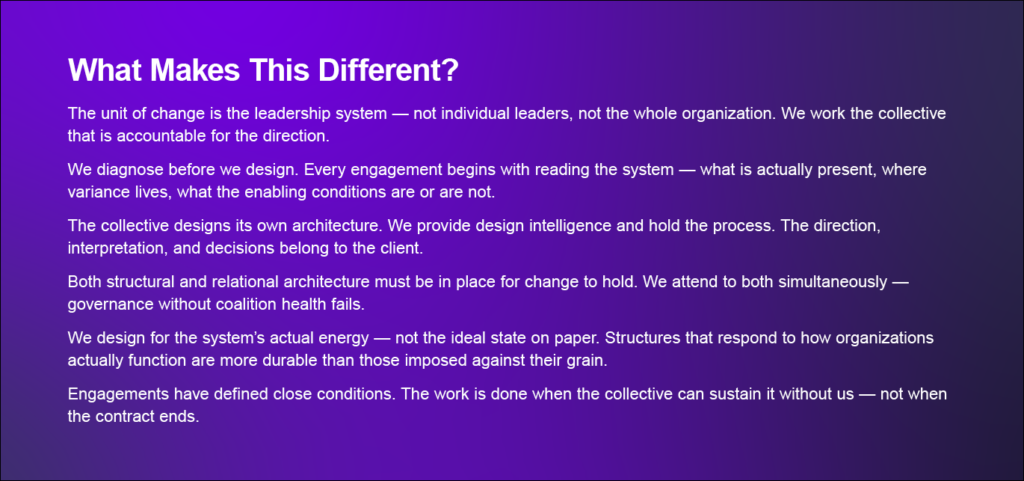
MCP is not a replacement for HR, Human Capital, or Learning & Development functions. It strengthens the operational and systemic conditions that determine whether those investments translate into mission performance. In practice, MCP often creates the role clarity, decision rights, and governance infrastructure that allow development and human capital efforts to stick — and the coalition health that allows coordination investments to hold across organizational boundaries.
MCP engagements are scoped to what the system needs. A lightweight diagnostic scan and executive debrief can stand alone as a bounded first engagement — creating a clear evidence base and a defined set of priorities. For organizations navigating sustained complexity, MCP can be structured as an ongoing partnership: embedded sensemaking, targeted capability work, and coaching support that allows the organization to adapt while it executes. Federal clients can engage through micro-purchase threshold, existing task order vehicles, or IDIQ contract structures including HCaTS, OASIS+, and GSA PSS.