
Written By
October 21, 2025

Turning Annual Staffing Plans into Strategic Assets. Federal Agencies Need New Capabilities, Not Just Compliance
By Alicia Rule, Mike Vajda, and Sharon Ginley
As a follow-on to The Strategic Hiring Paradox, which explored how federal agencies can move beyond compliance to build lasting workforce capability, this article examines the next critical step: translating the Executive Order’s Annual Staffing Plan requirement into a dynamic, mission-focused management tool.
Where the first piece emphasized sensing, prioritizing, and learning in the context of hiring freezes and limited resources, this article shows senior leaders how to operationalize those concepts in practice. The goal: turning static plans into living instruments that safeguard mission performance, enable strategic trade-offs, and foster adaptive capacity in an environment defined by uncertainty and disruption.
As illustrated below, the workforce planning environment has fundamentally shifted. Success now depends on agility, prioritization, consensus building, and strategic use of constraint.
Old Model vs. New Reality
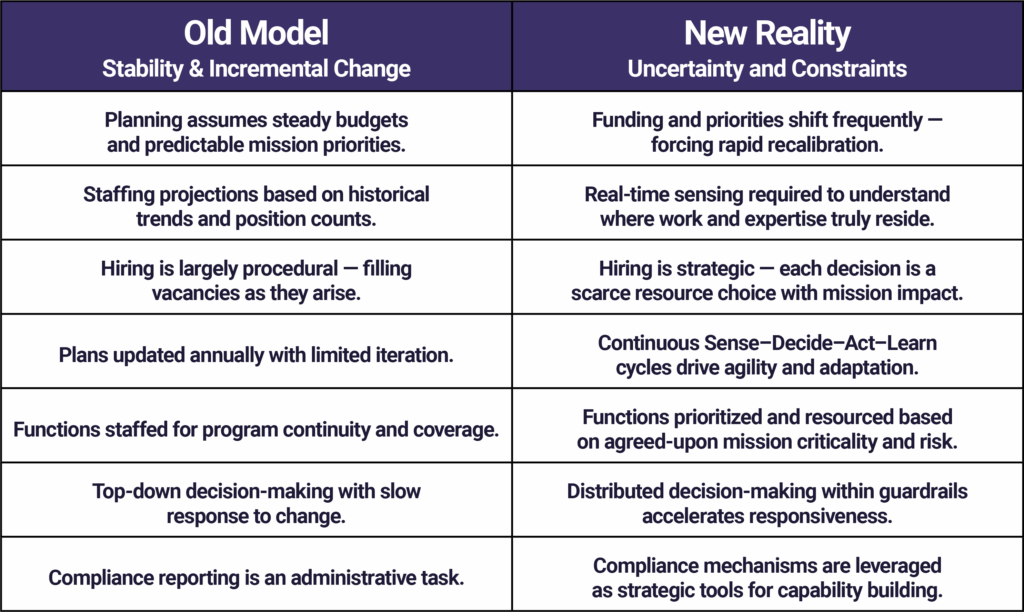
The Old Model Versus the New Reality
For decades, workforce planning in government assumed relative stability: steady budgets, predictable program scopes, and incremental personnel changes. Staffing models projected future needs based on historical patterns.
That model no longer fits. Today’s environment is defined by:
• Unpredictable funding and shifting priorities
• Heightened scrutiny and oversight
• Accelerated loss of institutional knowledge
• Strict limits on hiring and backfilling
Traditional planning methods (built for continuity, not volatility) can no longer ensure mission success. Leaders now need adaptive capability: the ability to sense emerging needs, make informed trade-offs, act decisively, and learn continuously.
Four Adaptive Capabilities for Senior Leaders
Agencies that succeed under the new Executive Order will cultivate four interdependent capabilities, together forming a Sense–Decide–Act–Learn loop that supports agile, data-driven leadership.
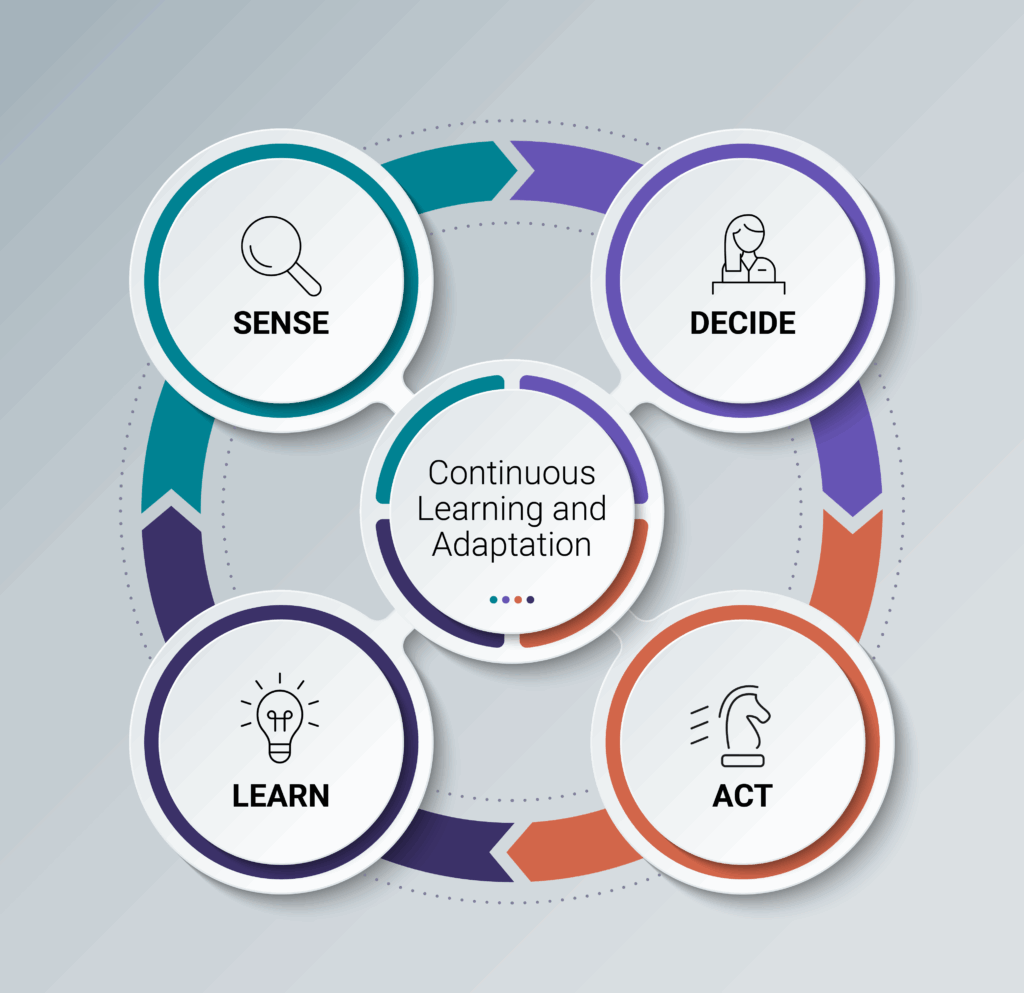
1. Organizational Sensing
Beyond position data, leaders need real-time visibility into where critical work and expertise truly reside.
That means understanding:
Example: Organizational sensing might reveal that your agency’s cybersecurity expertise is concentrated in three employees nearing retirement, allowing you to act before capability erodes rather than scrambling after they leave.
Organizational sensing enables early detection of risks, from the loss of a single expert to emerging skill gaps, allowing leaders to act proactively.
2. Strategic Trade-Off Frameworks
Every hiring or staffing decision now carries strategic weight. With limited authority to hire or reassign, agencies must prioritize roles and programs based on mission impact and risk, not tradition or convenience.
Establishing clear, transparent frameworks allows leaders to:
Example: When forced to choose between backfilling a long-standing administrative role or hiring a data analyst to support a critical new regulatory mandate, a strategic trade-off framework helps you assess which choice advances mission priorities and defend that decision to oversight bodies.
This is the discipline of strategic prioritization, ensuring that every position filled, retained, or repurposed directly advances the mission.
3. Rapid Experimentation
In times of constraint, inaction is riskier than iteration.
Rather than waiting for top-down reorganization, agencies can pilot small, low-risk initiatives (cross-training teams, redeploying staff, or testing new collaboration tools) to generate quick learning and scalable solutions.
Example: A regional office pilots a rotational program where staff spend 20% of their time supporting adjacent functions. Within 90 days, you learn what works, identify unexpected skill gaps, and have evidence to scale or pivot, all without permanent headcount changes.
Rapid experimentation helps agencies adapt faster than policy cycles, using evidence, not assumption, to guide workforce decisions.
4. Distributed Decision-Making
While Strategic Hiring Committees provide necessary oversight, the people closest to the work often have the clearest understanding of operational needs.
Empowering front-line program leaders to make targeted staffing decisions (within defined parameters) balances accountability with agility and builds shared ownership of mission outcomes.
Example: Rather than requiring every detail reassignment to flow through a centralized committee, establish clear guardrails (mission-critical functions, skill requirements, budget constraints) and empower division chiefs to make time-sensitive decisions within those boundaries.
From Annual Plan to Continuous Capability Development
The Annual Staffing Plan should not be a static compliance document. It should function as a strategic management tool, a living framework for aligning limited workforce capacity to the highest mission priorities.
Senior leaders should ask as they prepare their December submissions:
Agencies that use this process to test assumptions, identify trade-offs, and learn continuously will be better equipped to sustain performance even in prolonged uncertainty.
Leadership in a Constrained Era
Federal leadership today is defined by three core tensions:
Success in this era demands more than policy compliance. It requires leaders who:
Agencies that adopt this mindset will turn staffing plans into instruments of strategy, not bureaucracy.
How Golden Key Group Helps
At Golden Key Group, we partner with federal agencies to transform compliance into capability.
Our work helps leaders:
Our deep experience in workforce planning, leadership development, and organizational change equips agencies to move beyond reporting toward strategic workforce resilience.
Closing Reflection
December 15 is more than a due date. It’s a leadership moment!
Will your agency submit a staffing plan to check a box, or to build the workforce your mission actually needs?
About Golden Key Group
At Golden Key Group, we help federal organizations navigate constraint with purpose, designing merit-based, accountable, and high-performing workforces that advance mission outcomes even amid uncertainty.